
H. pylori Infection: Symptoms, Causes, Treatment & Patient FAQs
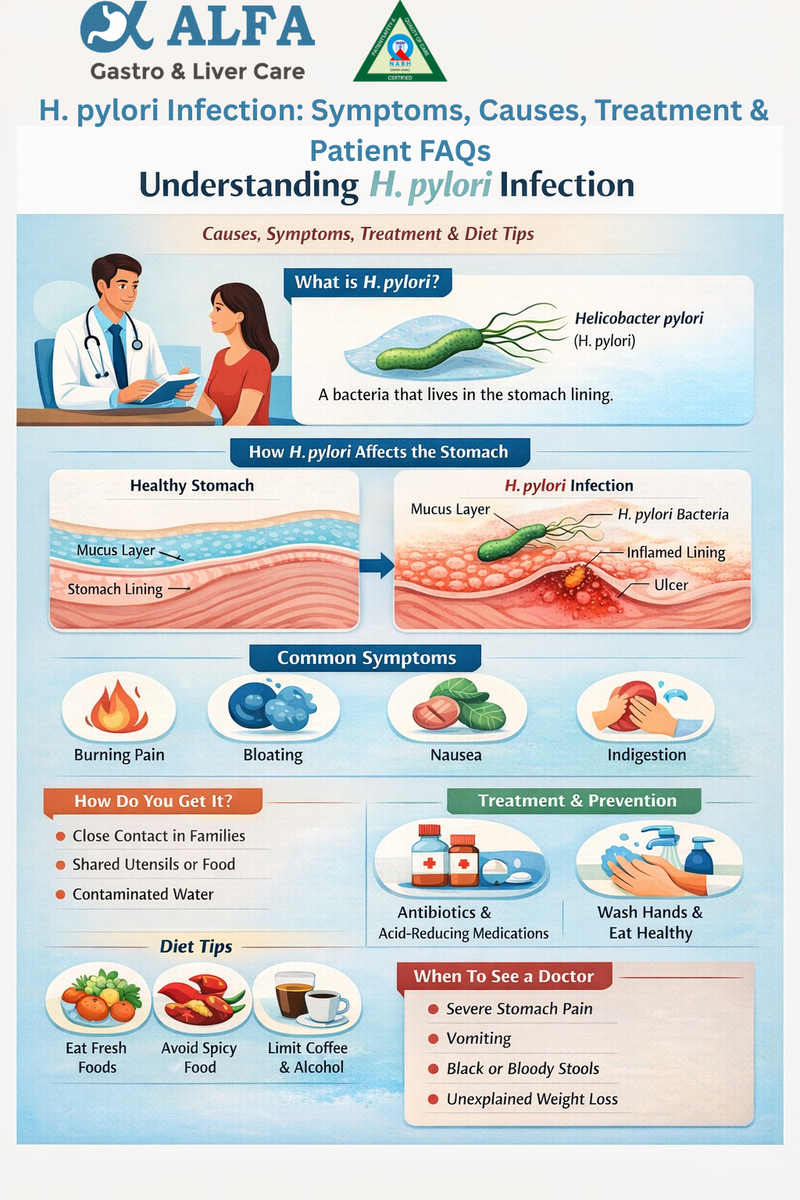
What is H. pylori?
Helicobacter pylori (Helicobacter pylori) is a common bacterium that lives in the stomach lining. Many people around the world carry this bacterium without knowing it.
Most people with H. pylori never develop serious problems, and many live their entire lives without symptoms.
How does H. pylori affect the stomach?
The stomach produces strong acid to digest food. To protect itself from this acid, the stomach lining has a protective mucus layer.
H. pylori can live within this mucus layer and may:
. Irritate the stomach lining
. Cause inflammation (gastritis)
. Sometimes lead to stomach or duodenal ulcers
. This process usually develops slowly over time.
. Suggested illustration for patient education
. A simple diagram showing:
. Normal stomach lining
. Mucus protective layer
. H. pylori bacteria living within the mucus
(This type of diagram helps patients easily understand the concept.)
Symptoms of H. pylori Infection
Many people have no symptoms.
When symptoms occur, they may include:
. Burning pain in the upper abdomen
. Bloating or gas
. Early fullness while eating
. Nausea
. Indigestion
These symptoms are usually treatable and manageable.
I Don’t Eat Outside Food. How Did I Get H. pylori?
This is one of the most common patient questions.
H. pylori infection is not only related to eating outside food.
In many cases the bacteria enter the body during childhood and remain in the stomach for many years without symptoms.
Possible ways it spreads:
. Close contact within families
. Sharing utensils or food
. Contaminated food or water during childhood
Having H. pylori does not mean poor hygiene or any mistake by the patient.
Why Did Symptoms Start Now?
In many people the infection has been present for years.
Symptoms may appear later because of:
. Changes in stomach acid levels
. Increased irritation of the stomach lining
. Stress or irregular meals
. Painkiller medications (NSAIDs)
. Sometimes there is no clear trigger.
Can H. pylori Cause Ulcers?
Yes, in some people it may cause:
. Stomach ulcers
. Duodenal ulcers
The good news is that ulcers caused by H. pylori usually heal very well with treatment.
Can I Get H. pylori Again?
Reinfection is possible but uncommon in adults.
After proper treatment:
Most patients do not get the infection again
Sometimes what looks like reinfection may actually be incomplete eradication from the first treatment
Treatment of H. pylori
Treatment usually includes:
Antibiotics to eliminate the bacteria
Acid-suppressing medications
The treatment course usually lasts 10–14 days.
Completing the full course of medicines is very important.
Diet Advice for Patients with H. pylori
Diet alone cannot cure the infection, but healthy eating helps reduce symptoms.
Helpful habits:
✔ Eat regular meals
✔ Eat fresh home-cooked food
✔ Drink clean water
✔ Include fruits and vegetables
Foods that may worsen symptoms in some people:
. Very spicy food
. Excess tea or coffee
. Alcohol
. Fried or oily food
. Each person’s tolerance may vary.
When Should You See a Doctor?
You should consult a doctor if you have:
. Persistent upper abdominal pain
. Frequent indigestion
. Vomiting
. Black stools or blood in stool
. Unexplained weight loss
. Early evaluation helps proper treatment.
Myths vs Facts about H. pylori
| Myths | Facts |
| Only people who eat outside food get it | Infection often occurs during childhood |
| Everyone with H. pylori gets ulcers | Most people never develop ulcers |
| It cannot be treated | Treatment is very effective |
| It always causes serious disease | Serious problems occur only in a small percentage |
Final Message for Patients
. H. pylori infection is common
. It is treatable
. Most people recover completely with proper treatment
. There is no need to panic. With proper medical guidance, the condition can be managed easily.